Written by Thet Oo Mon
Mandaing – February 13, 2026
The powerful Sagaing earthquake that struck in March 2025 caused extensive damage and losses across Myanmar. Even now, recovery and reconstruction remain extremely difficult.
Among the many impacts, one natural resource—vital to daily human survival—has also been seriously affected. After 2030, there is a real risk that this underground resource could become critically scarce.
That natural resource is none other than Groundwater, the water people rely on every single day. In Myanmar, most people believe that if you simply dig into the ground, water will appear (water will be found). Few stop to consider the actual condition of groundwater today: Will every well still yield water? Is the water safe to drink? Is its quality suitable for daily use?
Even before the earthquake, Myanmar’s groundwater was already under threat. The massive seismic shock further altered underground aquifers within affected regions. In some places, the original quality, quantity, and geological structure of groundwater-bearing layers changed dramatically.
Most of these aquifers are unconfined aquifers—layers of sand and sediment not tightly sealed or compressed. When subjected to intense seismic pressure and stress, their natural physical properties can change. Solid soil and rock layers may crumble and transform into loose, sand-like slurry, fundamentally altering groundwater behavior. It notes the technical term “Liquefaction”.
There is one person who explains these complex groundwater realities clearly and systematically—and who is deeply concerned about Myanmar’s groundwater future.
Though he does not currently live in Myanmar, he continues to warn the Myanmar people tirelessly about the looming groundwater crisis while residing in the United States for medical treatment (for heart disease) (because of Heart failure since 2017, and he is living with a Left Ventricular Assist Device, LVAD, under continuous Medicare).
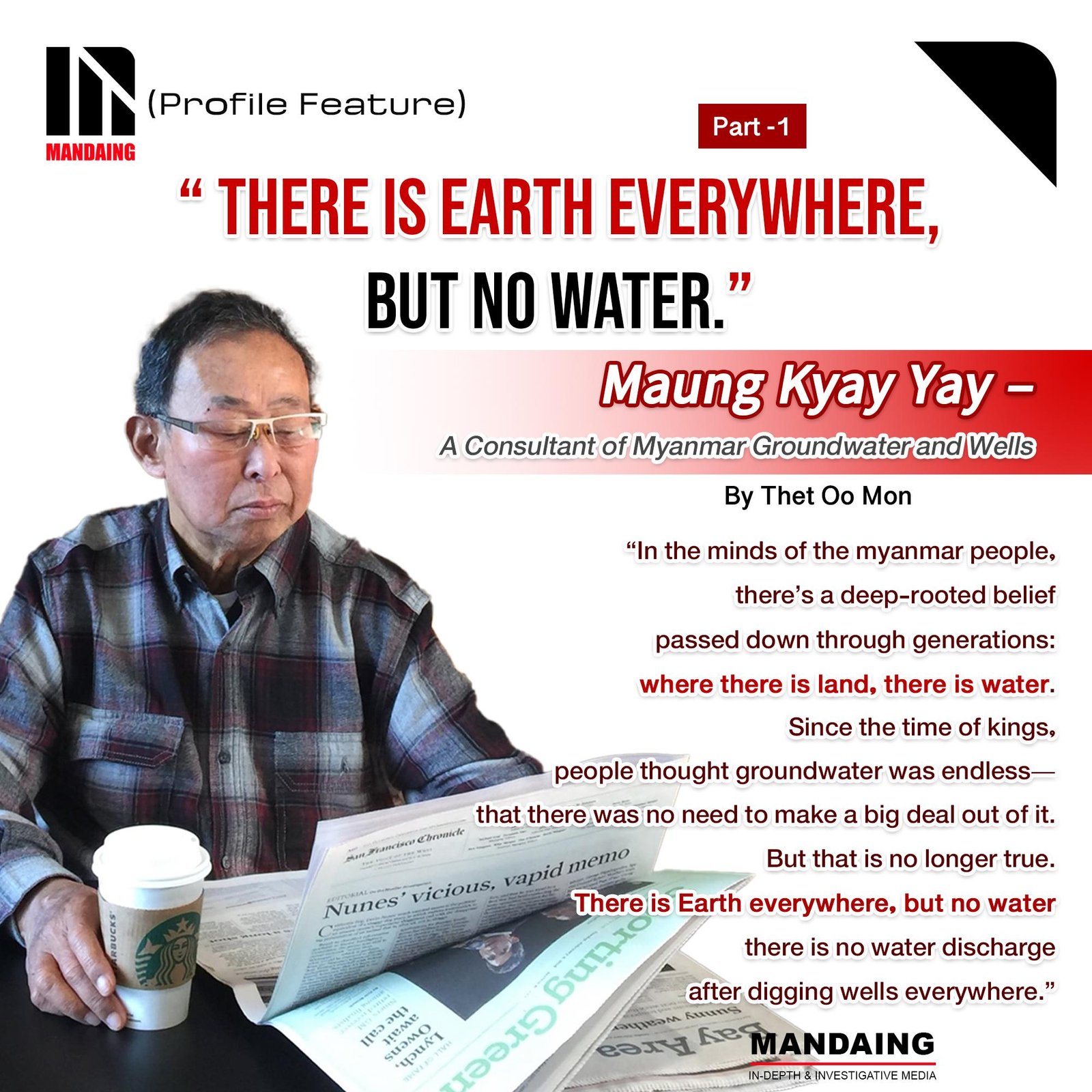
“In the minds of the Myanmar people, there’s a deep-rooted belief passed down through generations: where there is land, there is water. Since the time of kings, people thought groundwater was endless—that there was no need to make a big deal out of it. But that is no longer true. Today, There is earth everywhere, but no water after digging wells everywhere,” the expert said.
While Myanmar has many experts who understand surface water systems (rivers, lakes, and streams), those with a deep understanding of groundwater—the water hidden deep beneath the earth—are exceedingly rare.
Universities offer limited instruction in hydrogeology, and the field itself is constrained
limited professional work because there is no business with this profession in the groundwater industry in Myanmar. It is only in the relevant government department.
Yet, one rare figure has devoted his life to this work: senior hydrogeologist U Myint Thein, better known by his pen name Maung Kyay Yay, a National Literacy Award-winning writer.
Born in 1948, U Myint Thein is now 78 years old. He began his career in groundwater in 1980 at the Rural Water Supply Division (RWSD) of the Agricultural Mechanization Department (AMD). Before that, from 1975 to 1980, he served as an Assistant Geological Engineer at the Irrigation Department (now the Irrigation and Water Utilization Management Department (IWUMD)), where he conducted geological and groundwater investigations for dam construction projects.
He served at the RWSD for 14 years, from 1980 to 1994. During this period, he earned a postgraduate qualification diploma in groundwater exploration from the Netherlands (1978), and played a pivotal role in implementing national-level projects.
One major undertaking was an international rural water supply program that drilled over 3,000 tube wells across townships and villages in the Mandalay, Magway, and Sagaing Regions of the Dry Zone—areas collectively known as Myanmar’s Dry Zone.
This project was part of the United Nations’ “Water Decade” (1980–1990) initiative. Implemented by UNICEF and other international organizations, the initiative invited developing countries to improve rural water supply and sanitation. The project aimed to: Provide rural communities with easy access to clean drinking water, improve health, education, livelihoods, and economic conditions, and encourage community participation.
Myanmar was the first country in Southeast Asia to receive this project, securing over USD 40 million in funding. Additional support included: Equipment and materials for government departments, overseas scholarships for specialists, study tours, and international conferences for managers.
At that time, water scarcity in the Dry Zone was severe. Mechanized tube wells were rare, and people relied mainly on shallow, hand-dug wells along riverbanks. When the project villages finally secured a reliable water supply, a local saying emerged:
“We don’t want money. We don’t want gold. We only want water.”
The project significantly reduced water-related health issues and enabled health, education, and economic surveys that unlocked further development support.
For the RWSD, the initiative strengthened equipment, manpower, and technical capacity—elevating Myanmar’s entire groundwater sector. For U Myint Thein, it provided the foundation for his invaluable professional expertise.
Despite these setbacks, one major academic achievement was completed: the book “Hydrogeology of the Dry Zone – Central Myanmar,” based on the 3,000-well project carried out during the Rural Water Supply era. The publication was completed under the leadership of Dr Leonard Drury of the Australia Water Partnership (2017), with collaboration from Myanmar’s Water Resources Utilization Department. U Myint Thein contributed to this landmark work as an advisory hydrogeologist representing the National Hydrogeological Adviser of Myanmar.
Another project was initiated, namely “Sustainable Groundwater Yangon,” jointly with the Technical University of Delft in the Netherlands. This work involved systematically collecting and documenting detailed data on Yangon’s groundwater conditions: the number and types of tube wells in operation, their structural characteristics, groundwater depth, and water quality.
The study resulted in a comprehensive research paper that provided one of the most detailed groundwater records of Yangon at the time.
Before he left WRUD, he did a project, “Groundwater Database Management, Greater Yangon in 1991-92. The valuable groundwater data and information of 33 townships in the YCDC estate are recorded in tabular and map form.
He presented this research at the Department of Geology, University of Yangon, and submitted copies of the paper both to the university and to the United Nations Office United Nations Children’s Fund (UNICEF) in Yangon. During that period, his mentor, the late U Ngwe Thein, was serving with UNICEF as part of the Water Supply Office of Water Supply Office for the Tropical Zone Rural Water Supply Project.
Based on the data and technical information contained in this research, several university lecturers and students later wrote postgraduate theses and successfully obtained master’s and doctoral degrees. In 1993, U Myint Thein resigned from the Rural Water Supply Division.
From there, he moved to Singapore, where he worked as an Assistant Geological Engineer from 1994 to 1998. In 1998, he returned to Myanmar and, until 2003, worked as a groundwater and tube-well consultant, providing hydrogeological services together with his mentor, the distinguished groundwater expert U Ngwe Thein.
In 2004, he relocated once again to Singapore, where he spent 12 years (2004–2015) working in various professional capacities, including Geotechnical Engineer, Project Geotechnical Engineer, Senior Geotechnical Engineer, and Head of the Geotechnical Engineering Department at a MRT line construction company. In 2012, he began writing articles on groundwater and tube-well issues under the pen name “Maung Kyay Yay.” These articles were published in newspapers, journals, and online magazines.
He later explained that the pen name Maung Kyay Yay was chosen as a tribute to his years of service at the Rural Water Supply Division under the Department of Industrial Agriculture Agricultural Mechanization Department. For him, the department remained like a “first love” he could never forget. Beyond his own published works, he donated over 300 specialized books and research papers on groundwater and tube wells—materials he had studied and collected throughout his professional life—to the department for the benefit of future generations.
In 2018, he compiled his articles into a book titled “Essays on Groundwater and Water Issues.” The book received the National Literary Award (Applied Science) Writer. At the time, this award was most commonly won by medical doctors and engineers. He later noted with pride that this was the first book on groundwater in Myanmar to receive a national literary award.
However, his contribution to groundwater science did not end there. During the tenure of the NLD government, he served as a Groundwater Advisor advisory expert to the National Water Resources Committee (NWRC) from 2016 to 2020. He also guided students, teachers, and lecturers wishing to pursue postgraduate and master’s degrees in hydrogeology, providing mentorship, reference materials, and essential documents.
He actively participated in preparing research papers, engaging with international experts, and securing critical water-related projects aimed at improving Myanmar’s groundwater conditions. Notably, he collaborated with TU Delft (Netherlands) on the Sustainable Groundwater Yangon initiative, which sought to develop a systematic and sustainable groundwater management framework for Yangon City. Although preparations were underway to begin the project in 2021, it was abruptly halted after the military coup that same year.
During the NLD administration, he was also involved in securing projects for the comprehensive development and rehabilitation of the Ayeyarwady Integrated River Basin Management (AIRBM) Project Ayeyarwady River, aimed at improving national water resources. Unfortunately, these projects were likewise abandoned after the military takeover.
Despite these setbacks, a landmark academic achievement was completed: the book “Hydrogeology of the Dry Zone – Central Myanmar.” Based on the 3,000-well project from his early career, this work was published under the leadership of Dr Leonard Drury of the Australia Water Partnership (2017). U Myint Thein contributed to this definitive text as an National Hydrogeological Advisor advisory hydrogeologist representing Myanmar.
Since 2017, due to heart disease, Sayar Gyi has been living in California, United States. Even while abroad, he has continued to support the work of Myanmar’s National Water Resources Committee remotely.
I first discovered his work through an interview regarding how earthquakes affect groundwater systems. Having previously written articles on water issues, I had developed a personal interest in groundwater, but true experts in this field are exceedingly rare. When writing on technical topics, it is often difficult to find specialists who truly understand the subject and can explain it with clarity. Reading his interview, I felt a sense of relief and excitement—at last, I had found a genuine expert.
Driven by a desire to document his life story and professional contributions for future generations, I contacted him to request an interview. He readily and warmly agreed.
Despite his fragile health, he generously gave his time. Over ten sessions, to talling (?) nearly twenty-four hours of conversation, I gained a fascinating and in-depth understanding of: the growing dangers facing Myanmar’s groundwater sector, the systematic advancement of groundwater development since the 1980s, his lifelong passion for hydrogeology, his educational journey and the numerous national initiatives he participated in after Myanmar regained independence.
He also explained how the groundwater law, which had existed since the British colonial period, was effectively abandoned during the era of former Senior General Dictator Than Shwe. When the Groundwater Supervisory Office of the National Housing Board on Bogyoke Road in Yangon was dismantled, extraction—especially in Yangon—became entirely unregulated. As a result, groundwater resources across the country were placed in jeopardy.
To prevent this decline, he worked actively during the NLD administration to draft and enact a new Groundwater Law. However, following the military coup, the law was never implemented and was ultimately abandoned. This remains one of the most regrettable losses for Myanmar’s environment.
Had the law been enacted, it would have been possible to register all tube wells nationwide, monitor and control groundwater quality, prevent unlimited and uncontrolled drilling, and establish a comprehensive Groundwater Management System to manage resources and wells systematically.
The consequences of excessive groundwater extraction will be explained in detail in later chapters of this series.
I knew from the start that a single article could never fully portray the life and contributions of such a remarkable scholar. After completing our interviews, that realization became even clearer. Therefore, the life and work of U Myint Thein—one of Myanmar’s rare and invaluable groundwater experts—will be presented as a serialized feature.
The Early Childhood Life of Maung Myint Thein
Sayar Gyi is a native of Meiktila in the Mandalay Region. To be precise, his family lived on the eastern side of the great Meiktila Lake. He was born in December 1948, the very year Myanmar gained independence. He was the second-eldest son among seven siblings.
His father was a prominent commodities trader, dealing in Dry Zone agricultural products such as beans, maize, sesame, and cotton; he even established cotton ginning factories. His mother, meanwhile, was a woman of rare distinction for her time—she had passed Grade 10 during the British colonial period, an extraordinary achievement for a woman in that era.
However, U Myint Thein recalled, “During the British administration, even though most women could read and write Burmese, my grandfather told my mother that passing the tenth grade was already more than enough and instructed her to ‘hold the purse strings.’” Consequently, despite her education, she was only asked to manage the household and support the family business.
Sayar Gyi’s mother was an avid reader, and it was from her that young Myint Thein inherited a lifelong love of books. That habit became the seed from which his intellectual life would later grow.
“There was a bookstore in Meiktila called A Lin Yaung (Light). My mother bought newspapers such as Kyaymon, Myanma Alin, and the Mandalay Gazette, as well as novels, journals, and monthly magazines. Back then, a magazine or novel cost only two kyats per copy,” he said.
U Myint Thein completed his schooling up to Grade 10 in Meiktila. He was born into a financially stable and supportive family at a time when Myanmar—freshly independent—was full of hope and determination to progress. During Prime Minister U Nu’s administration, many citizens enjoyed relative economic stability.
The Burmese currency was strong around in that era; one U.S. dollar equalled just six kyats. A cup of tea costs one mat. One pyi (4–5 lbs.) of rice costs one mat. A tin of imported condensed milk from England costs five mu, while a viss of salt costs only thirty pyas.
In rural areas, people relied on kerosene lanterns, while only wealthier households could afford storm lanterns. Electricity was largely unavailable in villages, and firewood was the primary fuel. In towns, however, electricity was fully supplied. Meiktila hosted a five-day rotating market where villagers brought agricultural products and household goods to sell.
From surrounding villages came charcoal, tomatoes, onions, cabbage, radishes, and potatoes. From Yae Cho, Ma Hlang, Thea Taw, and Wundwin Townships arrived woven cotton textiles: Anyar blankets, Pinne cloth, jackets, and traditional cloth woven on backstrap looms. A fully loaded cart of firewood cost only 10 to 12 kyats, he recalled.
Bamboo-matted carts piled high with charcoal and firewood were vivid hallmarks of that era. Fathers drove the carts while women and children rode behind. Even today, U Myint Thein remembers the names of his grandmother’s friends.
“My grandmother’s friend was Daw Ywa. My grandmother’s name was Daw Htun May,” he reflected on the conditions of those still-underdeveloped times. “Whenever she came, what he said was truly worth remembering. It was a time when neither water nor electricity was plentiful.” When asked whether water was abundant in those days, the answer was no—it wasn’t. Electricity wasn’t plentiful either. People had to rely on kerosene lamps for light. The Lawpita power station had only just begun operating. Water had to be stored carefully, and firewood had to be stockpiled in preparation for the rainy season.”
“In those days in Meiktila, there were cars and trains for transportation, but cars were scarce. In the villages, ox-carts were commonly used. Within the town—whether travelling from place to place or going to the market—horse-drawn carriages were the main means of transport. Most people relied on horse carts to get around.”
Families who owned bicycles used them extensively. Middle- and high-school students rode bicycles to school. There were bus services between Thazi and Meiktila, including jeep lines. To travel from Meiktila to Yangon, one had to take a bus to Thazi Station, fourteen miles away, and then continue by train. The bus fare between Meiktila and Thazi was only three mats to one kyat.
Meiktila’s strategic position as a crossroads town ensured good transport links with Taunggyi, Kyaukpadaung, Mandalay, Myingyan, Taungtha, and Mahlaing Towns.
“In those days, there were famous trains named ‘Shwe Man May’ and ‘Yangon May,’” U Myint Thein recalled. “They were good trains, with dining restaurants onboard. A train ticket from Yangon to Mandalay costs only 25 kyats and one mat.”
Meiktila also had a well-known company store called GEC, where imported goods from England and India were sold. Everything was available—from miscellaneous items and ear swabs to nail clippers, bicycles, and car parts. Relay bicycles came in two varieties: British-made and Indian-made.
At a time when one tical of gold (16.33 grams) cost 82 kyats, a British-made bicycle cost 300 kyats, while Indian-made ones ranged between 250 and 280 kyats.
“An ordinary family couldn’t easily afford A brand-new bicycle,” he said.
Fortunately, U Myint Thein’s household owned bicycles, and because his grandfather also operated a pawn business, the siblings could rotate bicycles among themselves. They rode them to school every day.
Myanmar’s education system at the time ranked at the Top among the best in Southeast Asia. After independence and until 1975, the country continued to be based on the British colonial education system. In those days, passing high school in Myanmar made it possible to attend at schools in England. The reason was that, at the time, Myanmar was a member of the British Commonwealth, having been part of the British-administered dominions.
“At that time, Grade 9 was the high school final,” he explained. “Passing Grade 9 was equivalent to passing high school in England. You could enrol in law training, become a senior clerk if you left sam school, apply to be an air navigation guide at the Meiktila Air Base, or even join officer training.”
“In those days, the ninth grade was considered the High School Final. Passing the ninth grade was regarded as equivalent to completing similar like high school in England. With a ninth-grade education, one could take the entrance examination of Higher Grade Lawyer enrol in law training , and make a living as a lawyer. If you left school, you could secure a senior clerical position. You could also apply for a post as an air navigation guide at the Meiktila Air Force base. Alternatively, you could join as an officer cadet,” U Myint Thein explained how, at that time, the standard of education was remarkably high and employment opportunities were plentiful.
Education was divided into primary, middle, high school, and university levels. Primary school lasted four years, from ages five to nine, and instruction was mostly in Burmese. English was introduced at the middle school level. U Myint Thein attended only government schools.
Basic Middle School education lasted three years, covering Grades Five through seven. At the high school level, students studied a wide range of subjects, including geography, history, mathematics, physics, chemistry, English, and many others.
High School consisted of three years—Grades Eight, Nine, and Ten. The Grade Ten examination was designated as the Matriculation Exam, the official university entrance examination. What was remarkable in those days was that passing the ninth grade already qualified a person for a wide range of jobs, including positions as junior officers and commissioned officials. The ninth grade was regarded as the culmination of secondary education and was known as the High School Final. Upon passing the ninth grade, one was even eligible to sit for the Higher-Grade Pleader’s Examination in law.
The tenth grade could be described as the gateway to higher education. Only by passing the Matriculation Examination in Grade Ten could students proceed to study at universities. Even after completing the ninth grade, one was not yet eligible to enter university.
In those days, students aspiring to study engineering first pursued science majors—Physics, Chemistry, and Mathematics—and after completing their second year, transferred to engineering institutions. University instruction was conducted entirely in English, often by lecturers from India and England, making English proficiency essential.
Technical institutes and agricultural colleges received international support under programs such as the Colombo Plan. According to U Myint Thein, at that time, Myanmar’s Government Technical Institute (GTI) was superior even to Singapore Polytechnic.
In that era, Myanmar had only two universities—the University of Rangoon and the University of Mandalay. Colleges existed only in Taunggyi, Magway, and Mawlamyine. Myitkyina and Mawlamyine had not yet been elevated to university status. The famous writer Tekkatho Phone Naing was then the principal of Taunggyi College.
Universities and colleges enjoyed full autonomy and academic freedom, which contributed to their high standards. Admission was highly competitive. Sayar Gyi said that only about 25 per cent of students who sat for the Grade 10 exam passed.
The University of Rangoon, which was founded in 1920, attracted students from across the country and earned prestige both nationally and internationally. Leaders such as General Aung San and U Nu emerged from the University of Rangoon. During the 1940s and 1950s, its academic standing rivalled that of Calcutta University and Tokyo University.
However, after General Ne Win seized power in 1962, he reshaped the education system according to his own will. As a result, the system went into decline and, from that day to this day, has never fully recovered. U Myint Thein personally lived through that era of high educational standards and pursued his studies all the way to graduation.
He admitted that he once failed Grade 9, explaining that family circumstances were comfortable and he lacked focus that year. As a consequence, his parents sent him to Bago, where his uncle served as a district judge. His uncle’s father-in-law was U Thar Din, a member of the State Council under Ne Win, who had founded Special Grammar School in Bago and served as its principal.
U Myint Thein remained there until he passed Grade 9, then returned to Meiktila and successfully passed Grade 10 in 1967.
“At the time, my priority went to medical university, engineering, forestry, agriculture, and veterinary science. Only afterwards were students assigned to specialized disciplines,” he recalled. “My marks were neither high nor low. I scored just over 65 in ILA and applied to RIT, but I narrowly missed the cutoff. So geology became my specialization. In 1968, I entered the University of Mandalay.”
“Priority was given to Medicine, Engineering, Forestry, Agriculture, and Veterinary Science. Only after that did students branch out into specialized fields. My marks, however, fell somewhere in between—not high enough, not too low either. I scored over 65 in the ILA and applied to RIT (Rangoon Institute of Technology). Since my marks were just short of the cutoff, I applied only to RIT, but I wasn’t accepted. Instead, I was admitted to specialize in Geology, and in 1968, I enrolled at Mandalay University,” he said.
To be continued in Part Two.
(The next instalment will explore U Myint Thein’s university life in Mandalay and Yangon, his entry into professional life, and the social conditions of Myanmar during that period.)